
On an adventure day in March, Tom and I headed to Fort Amanda Memorial Park. We are working on visiting the places that are part of the Ohio History Connection. Ohio doesn’t have many places connected to the French and Indian War, the Revolutionary War, or the Civil War. But there are lots of places connected to the War of 1812.

Fort Amanda was a major supply depot for the American army during the War of 1812. It was one of a series of forts extending north from Piqua to Fort Meigs. Fort Amanda was built by order of General William Henry Harrison. Kentucky troops built the fort in the fall of 1812. Ohio militia soldiers doubled the original size during the spring of 1813 under the command of Capt. Daniel Hosbrook.

The original fort is no longer standing, but a granite monument built in 1915 marks the site of the fort. Located on the banks of the Auglaize River, the park also features a historic cemetery. Trails lead through wooded ravines, down to the river or out to the monument. Fort Amanda is managed locally by the Johnny Appleseed Metropolitan Park District.
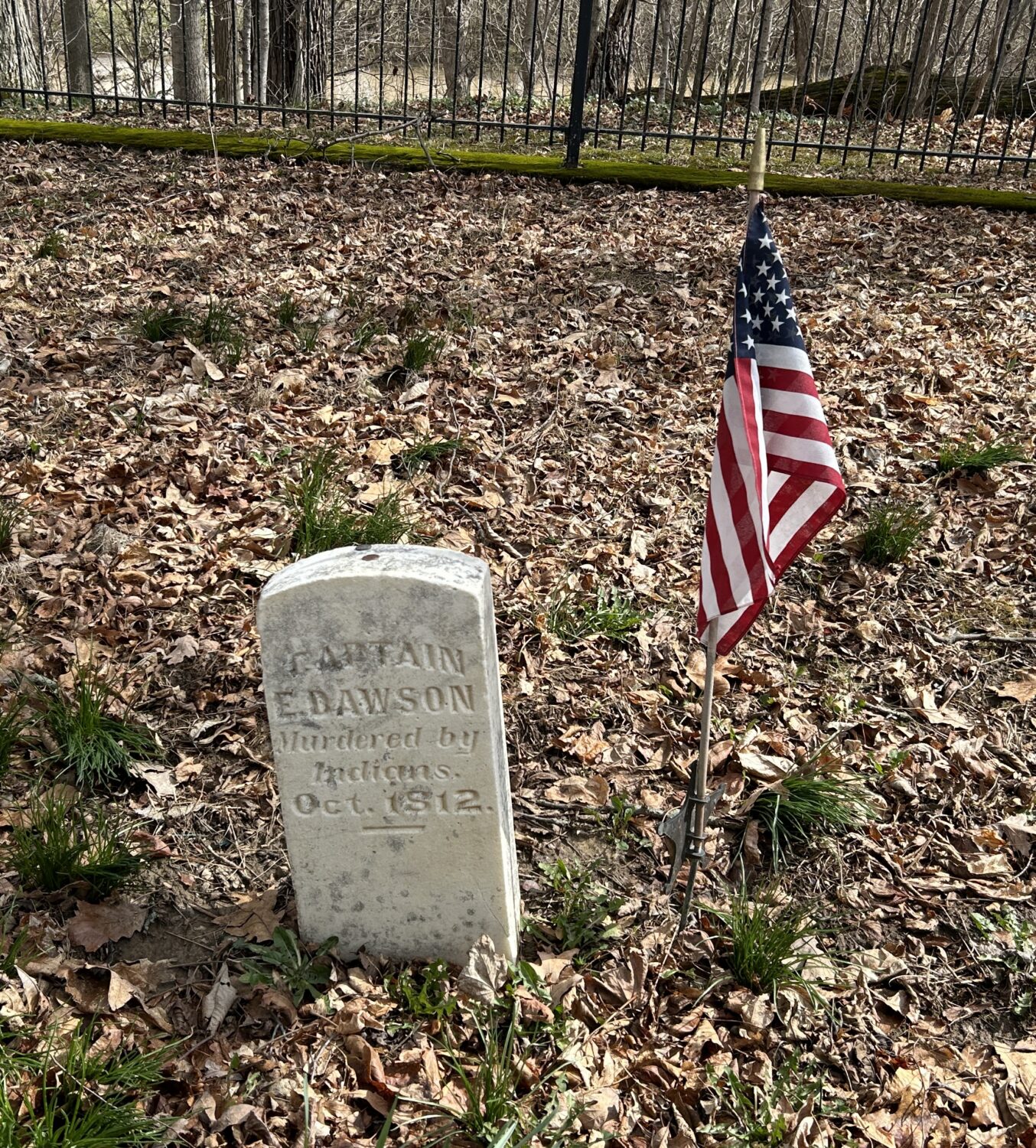
Tom and I visited Fort Amanda Memorial Park on a cold and windy Friday in March. We were the only ones at the park. We read the signs about the history of the park and walked the trail to the granite marker. On the way to the marker, we walked by the cemetery which has the graves of 75 soldiers who died during the War of 1812. The only one who had a name was Captain E. Dawson, “murdered by Indians.” The cemetery is still in use today so there were lots of modern headstones.

The cemetery has a great view of the Auglaize River which was running high and fast after the spring rains. We admired the very tall granite marker situated at the probable site of the fort. But it was too cold to admire the view for long, and we soon headed back to the car.

On the way back, we learned about the history of the site after the War of 1812. The fort was soon abandoned, but early settlers to the area used the buildings and materials to construct homes in the area. The monument was placed on the site in 1915. In the 1930’s the Civilian Conservation Corps constructed a shelter house and restrooms that are still in use today.
It was interesting to learn about this piece of Ohio history. We were impressed with the signage at the site and the care that was being taken of the park. It looked like a great place to learn history and have a picnic – on a warmer day.