
On our last trip to Ohio, Tom and I stopped by Berea College in Berea, Kentucky. I have wanted to stop by there for a long time. The people who are knowledgeable about textiles often mention Berea College to me when they visit my textile room. Berea College has a public-facing weaving program and has since its inception. They also have a student artisan gift shop and a brand new Visitors Center.
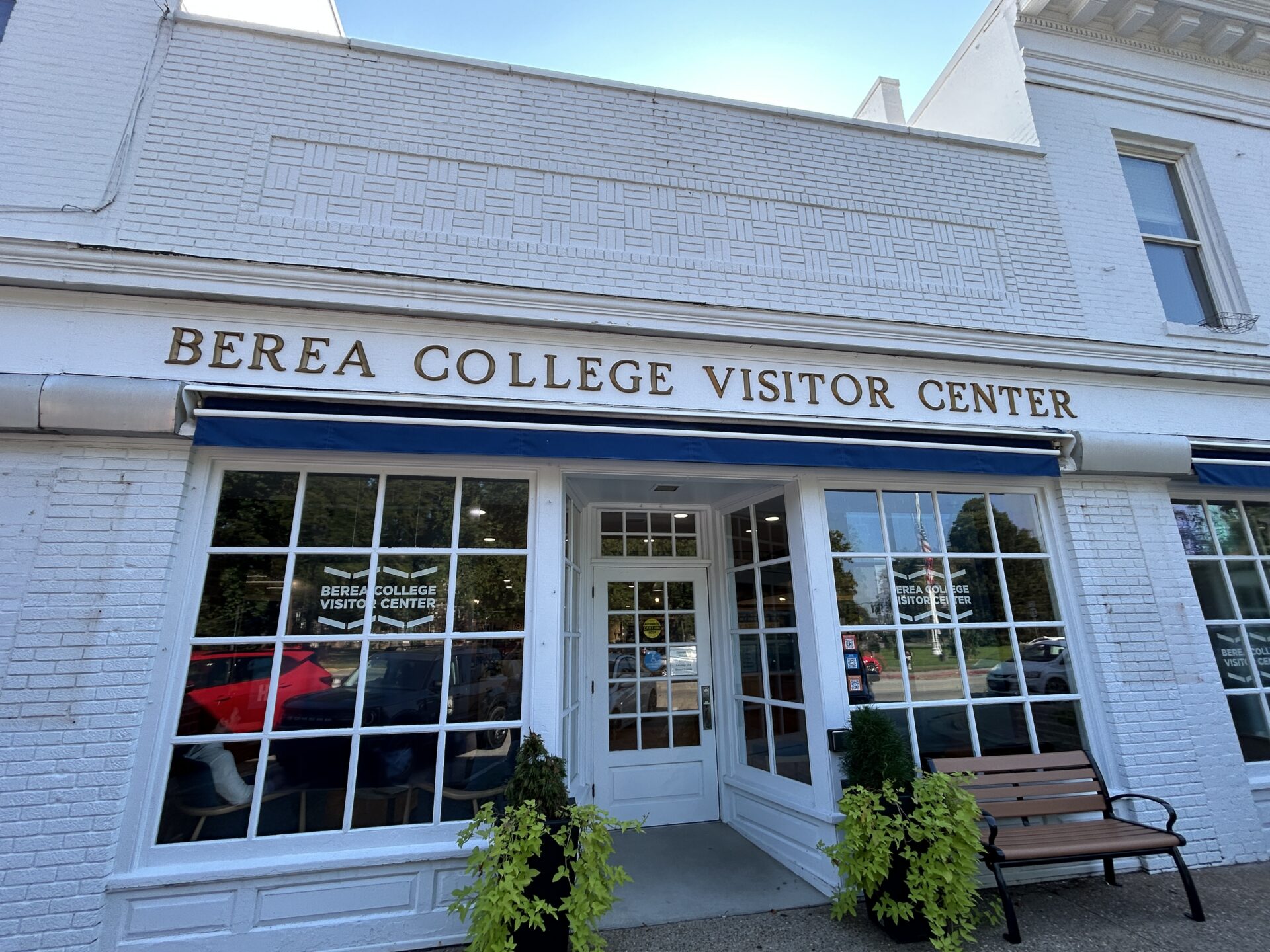
Tom and I stopped by the new Visitors Center to check out Berea College. We were impressed even before we arrived. The town of Berea has grown around the college. Because of the emphasis on arts and preserving history, Berea is a lively place to settle. It is attracting a lot of folks with its music, arts, and restaurants and is one of the fastest growing cities in Kentucky.
The center and the heart of the city is Berea College. The college was founded in 1855 by John Gregg Fee, an ardent abolitionist. Although the college was granted land and had a building, Fee and the other teachers were forced out of the area by advocates of slavery. Fee spent the next decade raising money among the abolotionists in Ohio and teaching the free black people at Camp Nelson. The college reopened in 1866. Berea College was the first college in the south to be racially integrated and co-educational.

Over time, as Jim Crow laws took hold in the south, pressure was put on Berea to segregate. When the college refused, the Kentucky Legislature passed a law declaring that schools must be segregated. Although Berea College fought the law all the way to top, the Supreme Court ruled against them. From 1904 until 1954, Berea ran a satellite school specifically for black students. After Brown v the Board of Education in 1954, Berea College quickly desegregated.
In addition to its commitment to desegregation, I was most impressed by Berea College being a tuition-free college. The college participates in federal work-study and work college programs that cover the remaining tuition fees after subtracting the total sum a student receives from Pell Grant, other grants, and scholarships. Most of the college’s students come from southern Appalachia. Students also come from more than 40 states in the United States and 70 other countries. Approximately half of them are people of color. Most of them are also the first person in their family to attend college. And, because of this fully-funded education, the vast majority of the students live on campus.
Berea offers bachelor’s degrees in 33 majors. Every student works a minimum of 10 hours per week at a campus job in one of more than 130 departments. In working on campus, students support the operations and mission of the College and also gain important workplace experience. Because every student works, Berea is a model of equity across race, class, and gender.
In 2024, Washington Monthly ranked Berea College first in the U.S. among national liberal arts colleges based on its contribution to the public good. The New York Times also ranked Berea first in its 2023 College Access Index based on economic diversity. The 2025 annual ranking of U.S. News & World Report categorizes Berea as “more selective” and rates it 40th overall, first in “Service Learning,” second for “Most Innovative Schools,” tied for 9th in “Best Undergraduate Teaching”, and fifth in “Top Performers in Social Mobility” among U.S. liberal colleges.

I learned all the above information through the displays at the Visitors Center and on the college web page. After wandering through the exhibits, Tom and I also explored the small student-artisan gift shop. We saw things students made for sale. There were brooms, pottery, musical instruments, and woven items. All of them were beautiful works of art and the price reflected the craftsmanship.

Tom and I were completely impressed by our visit to Berea College. The college impresses on many different levels. It has a beautiful campus. A diverse student body. The college values traditional arts and crafts of the community. And it is committed to improving students’ lives by offering an affordable education.